How to Use a Chess Clock: A Beginner’s Guide
A chess clock is really two timers joined together: only one runs at a time. When you finish your move you press your button, your timer stops and your opponent's starts. It keeps games moving and stops anyone from thinking forever.
Short answer: set both sides to the same time, let White's clock run first, and after every move press the button on your side with the same hand you moved with. If your time reaches zero you lose, unless your opponent has no way at all to checkmate you, in which case it is a draw.
How to use a physical chess clock, step by step
- Set the time for both players, for example 10 minutes each (and an increment if your clock supports it).
- Place the clock beside the board on the side where the person keeping track (or the arbiter) can see it; both players must be able to reach their button.
- Start White's clock. In casual games Black usually presses their own button, which starts White's time.
- Move, then press. Complete your move first, then press your button with the same hand you moved with.
- Watch both times. When a time reaches zero, that player's "flag falls".
Increments and delays
A time control such as 5+2 means 5 minutes for the whole game plus 2 seconds added after each move. That bonus is called an increment (or Fischer increment). It stops games from being decided only by who can move fastest in a lost-on-time scramble.
Some clocks also offer a delay (common in the US): the clock waits a few seconds before it starts counting down each move. The idea is similar, but unused delay time is not saved up.
Time controls for casual games
| Name | Typical setting | Good for |
|---|---|---|
| Bullet | 1+0 | Fast, experienced players; very chaotic |
| Blitz | 3+2, 5+0 | Quick games between friends |
| Rapid | 10+0, 10+5 | Most casual games: time to think, still finishes in about 20–30 minutes |
| Classical | 30+ minutes | Serious games and clubs |
| No clock | Unlimited | Teaching, learning and relaxed games |
Beginners usually enjoy 10+5 or no clock at all; blitz rewards speed more than understanding.
What happens when time runs out
The player whose time runs out loses, with one important exception: if the opponent cannot possibly checkmate (for example, they have only a king, or only a king and one bishop or knight against a bare king), the game is a draw. A flag falling against a lone king is a draw, not a win.
Using the clock on this site's board
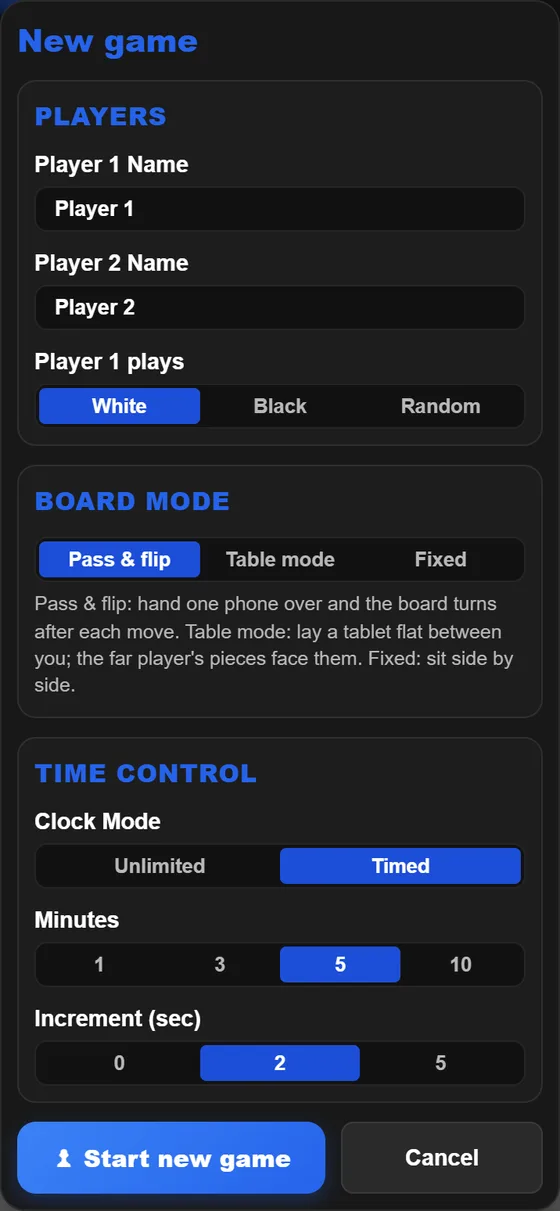
The two-player board has a built-in clock for games played on the screen: pick 3, 5 or 10 minutes under Options on the start screen, or open New game for 1 minute and a 2 or 5 second increment. Each clock appears next to its player's name, and the clock follows the draw rule above. It is a game clock for the on-screen board, not a standalone timer for a physical board; for that, use a real chess clock or a dedicated chess-clock app.
Questions
Which side of the board does the clock go on?
In tournaments the arbiter decides (usually so they can see it). In casual games, put it wherever both players can reach their button comfortably.
Can I press the clock before finishing my move?
No. Complete the move first; pressing early counts as a rule breach in tournaments.
What does 10+5 mean?
Ten minutes for the whole game per player, plus five seconds added after every move.
Try it on a real board: free, no sign-up, set up in seconds.
♟ Play a two-player game